How Paul Built a Business That Could Grow Without Taking on a Huge Overhead
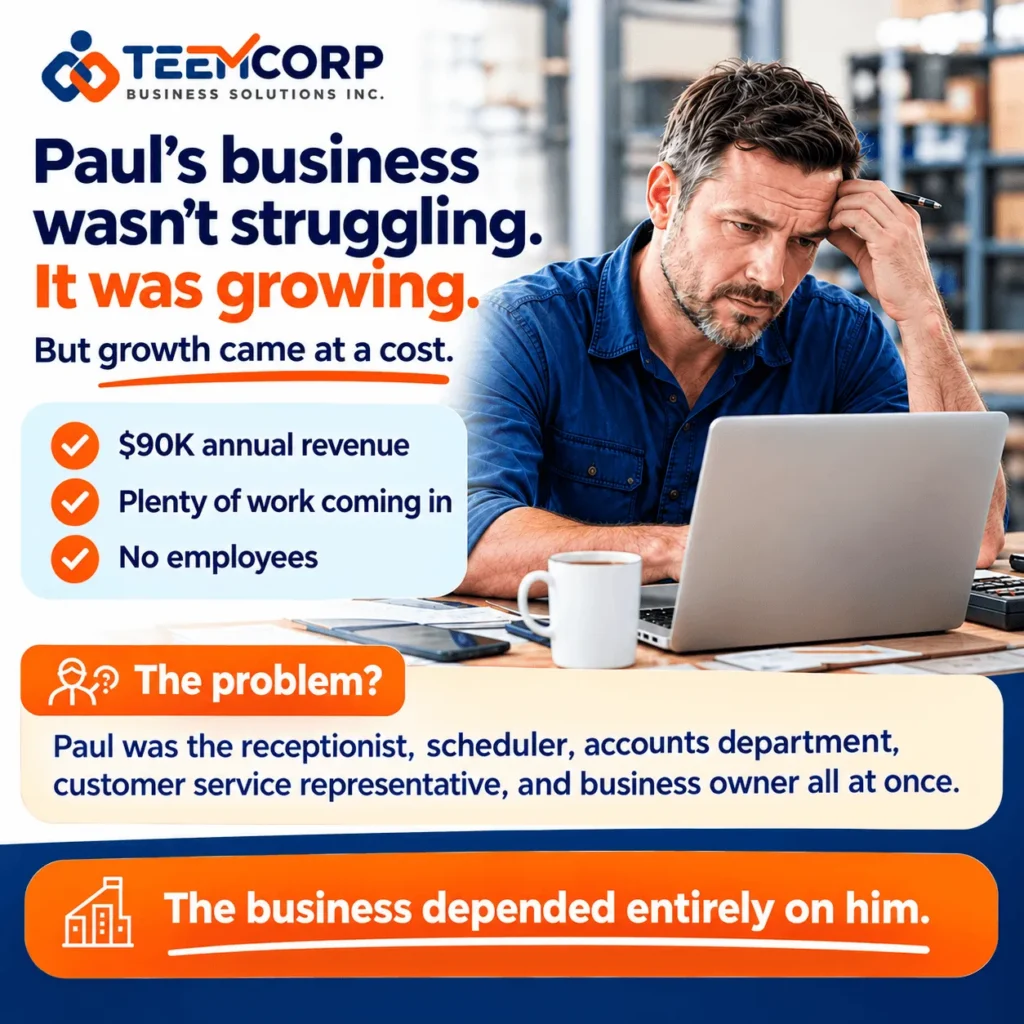
Many Australian small business owners face the same challenge: demand is growing, but there simply are not enough hours in the day. As businesses expand, owners often find themselves managing customer enquiries, scheduling, invoicing, administration, technology, marketing, and service delivery all at once. While this hands-on approach helps businesses get started, it can eventually become the biggest obstacle to small business growth. This small business case study explores how one Australian trade services business created additional capacity, improved operational efficiency, and built scalable business systems that supported long-term growth. Paul built his trade services business from the ground up. After four years of hard work, the business was generating around $90,000 per year. Demand was steady, customers continued to enquire about services, and Paul had earned a strong reputation within his local market. However, one challenge continued to hold the business back. Despite the growing demand, the business could not grow any further without him. Like many owner-operated businesses, critical functions such as customer service, scheduling, invoicing, administration, technology, and marketing remained heavily dependent on the owner. Although this approach worked in the early stages, it eventually became a barrier to sustainable growth. The business was not short of demand. Instead, it was short of capacity. As a result, growth opportunities became increasingly difficult to manage, even though there was no shortage of work available. According to the Australian Chamber of Commerce and Industry, many Australian businesses continue to face ongoing skills shortages and rising labour costs. Consequently, many organisations are exploring alternative workforce models and overseas talent solutions to access specialised skills, improve operational capacity, and support sustainable small business growth. The Small Business Growth Challenge Facing Australian Business Owners Like many small business owners, Paul gradually became responsible for every function of the business. At first, this did not seem like a problem. When you start a business, wearing multiple hats is often necessary. Not only does it reduce overheads, but it also helps owners understand every aspect of their operations. However, as revenue grows and customer demand increases, the same approach can become a serious limitation. For Paul, administrative work was beginning to pile up. Meanwhile, customer response times were becoming slower. In addition, new opportunities were being missed simply because there was not enough time available to follow them up properly. Most importantly, every hour spent on administration was an hour not spent generating revenue. As a result, Paul began to realise that the real question was not: How do I get more customers? Instead, the question became: How do I create enough capacity to serve more customers? That shift in thinking ultimately changed the direction of the business. Rather than immediately hiring additional tradespeople or increasing fixed overheads, Paul decided to identify exactly where his time was being consumed. The answer was clear. Simply put, too many important business functions were dependent on the owner. Consequently, every operational issue, customer request, and administrative task eventually made its way back to Paul. To solve the problem, he partnered with TeemCorp’s Workforce Solutions team to identify practical ways to create additional capacity without significantly increasing local staffing costs. Creating Capacity Through Workforce Solutions To begin with, the first recommendation was straightforward. Paul needed administrative support that could take ownership of routine yet essential business functions. As a result, he could spend more time focusing on revenue-generating activities and long-term business development. A highly qualified personal assistant was brought into the business, taking responsibility for: This support formed part of a broader https://teemcorp.com.au/business-support-services/business support services strategy designed to reduce owner workload, improve customer responsiveness, and create additional capacity for growth. However, the support extended far beyond administration. The assistant became a valuable point of contact for customers and helped ensure enquiries were handled promptly. For example, when Paul was travelling between jobs, the assistant could monitor schedules, provide updates to customers, and answer routine questions on his behalf. Although these tasks may seem small individually, together they delivered significant improvements. As a result: The investment was approximately $2,000 per month. However, for Paul, it represented far more than the cost of an assistant. Instead, it was an investment in buying back his time, improving efficiency, and creating capacity for future small business growth. From Working in the Business to Working on the Business Before hiring support, most of Paul’s day was spent reacting to immediate demands. Customer calls needed attention. Emails required responses. Quotes had to be prepared. Invoices needed to be issued. Meanwhile, scheduling and customer updates continued to compete for time. Consequently, strategic activities such as planning, marketing, business development, and process improvement were often pushed aside. With support in place, Paul could finally focus on the activities that drive long-term success. These included: This represented the first major shift in the business. Nevertheless, administrative support alone would not create a scalable operation. To achieve sustainable small business growth, Paul also needed documented systems, stronger processes, and technology capable of supporting future expansion. Frequently Asked Questions About Small Business Growth How can a small business create more capacity? Small businesses can create additional capacity by delegating administrative work, outsourcing specialist functions, implementing systems, and adopting technologies that reduce manual tasks. When should a business hire administrative support? Administrative support becomes valuable when business owners spend more time handling operational activities than focusing on revenue generation, sales, customer relationships, and business growth. Why are systems important for business growth? Systems improve consistency, reduce errors, increase efficiency, and make it easier for businesses to scale without relying on a single individual. What are the benefits of workforce solutions? Workforce solutions provide access to skilled professionals, improve operational capacity, support growth, and help businesses manage costs more effectively. How can business support services improve efficiency? Business support services help reduce administrative workloads, improve responsiveness, streamline operations, and allow business owners to focus on strategic growth activities. Is Your Small Business Growth Being Limited by Capacity? If you are spending too much time on administration, customer enquiries, scheduling, invoicing,
Business Growth Solutions for SMEs

Business Growth Solutions for SMEs Home Service Details July 31, 2026 Managing Remote Teams Successfully: Your Guide July 27, 2026 Business Growth Solutions for SMEs +61 08 6140 1817 Email Us: info@teemcorp.com Contact Us Business Growth Solutions for SMEs: How Australian Businesses Can Build Better Teams Without Growing Complexity When most people think of Spider-Man’s web, they think about catching villains. However, not all webs are meant to trap. Some webs create connections, strengthen relationships, and make movement easier That simple idea inspired our recent social media post. More importantly, it reflects what many Australian SMEs are experiencing today. Although opportunities remain available, workforce shortages, rising operating costs, technology demands, staff retention concerns, and capacity constraints continue to challenge business owners. As a result, many businesses aren’t struggling to generate work. Instead, they’re struggling to find the capacity needed to support growth. In many cases, the issue isn’t demand. Rather, the challenge lies in building the right team, implementing suitable systems, and creating processes that support sustainable growth. Consequently, effective business growth solutions for SMEs focus on increasing capacity through people, technology, and operational improvements. Why Many SMEs Hit a Growth Ceiling Many business owners assume growth comes from generating additional leads. While attracting new customers remains important, an increasing number of SMEs discover that capacity becomes the limiting factor long before sales do. For example, the warning signs often include: Too much work sitting in the pipeline Delays in project delivery Administrative bottlenecks Difficulty finding reliable staff Owners spending excessive time on operations Technology frustrations reducing productivity Because of these challenges, growth can quickly become stressful rather than exciting. Businesses frequently compensate by working longer hours, making rushed hiring decisions, or relying on disconnected systems. Eventually, those temporary solutions create even more complexity. Why Capacity Matters More Than Ever The business environment has changed significantly over recent years. Australian SMEs continue to face operating cost pressures, workforce shortages, cash flow concerns, and increasing technology requirements. At the same time, businesses are looking for practical ways to improve productivity while maintaining profitability according to recent news. Meanwhile, the pace of technology continues to accelerate. AI platforms, workflow automation, cybersecurity requirements, cloud applications, and digital collaboration tools are now part of everyday business operations. However, many businesses lack the internal resources required to implement and manage these technologies effectively. As a result, business owners often ask: How can we grow without significantly increasing overheads? How can we improve productivity without adding complexity? How can we find the right people? How can we manage technology efficiently? These questions all relate to capacity rather than sales. Therefore, successful growth strategies focus on removing operational bottlenecks before pursuing additional expansion. The Three Most Common Growth Obstacles Recruitment Delays Finding the right person takes time. During the recruitment process, existing team members often carry additional responsibilities, projects slow down, and service quality may be affected. Furthermore, businesses may miss valuable opportunities while waiting for additional support. Finding suitable talent is only part of the challenge. More importantly, businesses need access to skills and resources when capacity demands increase. Consequently, organisations that can quickly scale support are often better positioned to take advantage of growth opportunities. Disconnected Systems Many SMEs build operations over time using multiple software platforms, spreadsheets, manual processes, and email-based workflows. Initially, this approach seems manageable. As the business grows, however, information becomes fragmented, reporting becomes more difficult, and efficiency starts to decline. Furthermore, disconnected systems often create duplicated effort, reduce visibility, and increase manual work. As a result, businesses spend more time managing information and less time delivering value. The Owner Becomes the Bottleneck Another common challenge occurs when too many responsibilities remain with the business owner. Operations, administration, recruitment, customer service, business development, and technology decisions often compete for attention. Although revenue may continue to grow, owner capacity remains limited. Consequently, decision-making slows, operational pressure increases, and the organisation becomes heavily dependent on one individual. Over time, this limits scalability and increases risk. Business Growth Solutions for SMEs: Build Connections, Not Complexity Businesses that scale successfully typically take a different approach. Rather than adding layers of complexity, they strengthen the connection between people, systems, and processes. People The right people create capacity. However, growth isn’t simply about increasing headcount. Instead, successful organisations focus on placing the right people in the right roles at the right time. Examples include: Administrative support Customer service support Accounting support Operations support Specialist project resources As a result, productivity improves while workload pressures decrease. Systems Reliable systems create consistency and efficiency. For this reason, growing businesses frequently invest in: Business email systems Cloud storage Document management Website platforms Cybersecurity solutions Workflow automation Rather than creating additional challenges, technology should simplify work and improve efficiency. Furthermore, modern systems improve collaboration, increase visibility, and support better decision-making across the business. Processes Clear processes create scalability. Without documented workflows, businesses become heavily dependent on individual knowledge. Consequently, training becomes more difficult, consistency declines, and growth becomes harder to manage. Documented processes help businesses: Deliver work consistently Train employees faster Reduce errors Improve visibility Scale efficiently Why Workforce Solutions, IT Solutions, and Growth Support Must Work Together Many businesses attempt to solve problems in isolation. Some hire more staff without improving systems. Others invest in technology without providing the support needed to use it effectively. Similarly, some focus on business growth before building sufficient operational capacity. Unfortunately, isolated improvements rarely deliver maximum value. Instead, sustainable growth occurs when people, systems, and processes work together. Workforce Solutions When businesses add capacity in the right areas, they can: Reduce workload pressure Improve response times Support growth initiatives Increase flexibility Consequently, organisations can improve service delivery while reducing pressure on existing employees. IT Solutions Reliable technology helps businesses: Improve efficiency Reduce manual work Strengthen cybersecurity Enable remote collaboration Support scalable operations Similarly, strong technology foundations allow businesses to grow without creating unnecessary complexity. Growth Support Growth support helps businesses: Streamline operations Improve productivity Increase visibility Focus on strategic goals Ultimately, these improvements allow