From an Owner-Dependent Accounting Practice to a Scalable, Higher-Margin Business

Revenue Without Capacity Arthur’s accounting practice was generating approximately $300,000 a year in fees. The business had revenue. However, it was heavily dependent on Arthur. He was working around 80 hours a week. Much of his time was spent on administration, ASIC work, lodgements, correspondence, collecting client information, and routine accounting tasks. Arthur was effectively filling every role in the business. He was the principal, accountant, administrator, and operations manager. As a result, there was little time left for networking, business development, client relationships, or higher-value advisory work. The commercial opportunity was clear. Arthur needed to delegate work that did not require his direct involvement. He also needed to create additional delivery capacity. Most importantly, he needed to spend more time on activities that could grow the practice. Build the Infrastructure for Scale The first step was to improve the practice’s IT environment. With TeemCorp’s assistance, Arthur moved his server and key systems to the cloud. This created a more flexible and secure platform for staff working from different locations. However, this was more than an IT upgrade. It created the operating foundation for a remote team. It also made it possible to separate the work of running the practice from the work that only Arthur could do. This distinction was important. Arthur did not need to personally complete every task. He needed the right systems and people to support the business. Delegate Administration and Buy Back Capacity Arthur then employed a dedicated administration team member in the Philippines. The annual employment cost was approximately $22,000. The team member took responsibility for a range of routine and process-driven activities, including: This allowed the practice to allocate routine administration to a dedicated team member. An experienced accountant no longer needed to spend as much time on administrative tasks. The result was more than a reduction in overhead. It created additional principal capacity. Arthur could now spend more time with clients. He could also attend networking and referral meetings, build professional relationships, and generate new work. In other words, the practice was buying back Arthur’s time. Add Offshore Accounting Capacity As the practice grew, Arthur employed a Philippines-based accountant. The annual employment cost was approximately $28,000. The additional accounting resource created another layer of delivery capacity. Routine accounting and compliance work could now be completed by the offshore accountant and reviewed by Arthur. Previously, Arthur had often performed the work personally from start to finish. This changed the way the practice operated. The business could: Delegation created capacity. Offshore staffing reduced delivery costs. At the same time, Arthur’s freed-up time created more opportunity for business development and growth. The Practice Today Arthur’s practice now operates with four Philippines-based staff. The business also uses TeemCorp’s broader staffing, IT, and marketing capabilities to support its operations and growth. What began as a $300,000-fee practice that depended heavily on one principal working approximately 80 hours a week has developed into a more scalable business. It now operates with a substantially lower operating cost structure. After allowing for Arthur’s own commercial wage, the practice now operates at approximately a 62% net profit margin. The improvement did not come from one single change. Instead, it came from redesigning how the business worked. Administration was delegated. Accounting capacity was added. Routine work was completed at a lower delivery cost. Arthur’s time was redirected towards higher-value activities. Together, these changes created a more scalable operating model. From Doing the Work to Directing the Business Previously, Arthur was the person who completed much of the work. Today, he can focus more of his time on the responsibilities that require the principal. These include: The shift is significant. Arthur is no longer spending the majority of his time as the primary delivery resource. Instead, he can focus on directing the business, developing relationships, and creating opportunities for the team to deliver. The goal was not simply to work fewer hours. The goal was to change what Arthur spends his time doing. What This Means for Business Owners Offshoring Is More Than a Cost Decision Offshoring is not simply about replacing Australian labour with lower-cost labour. Used properly, it can help redesign the economics and operating structure of a business. In Arthur’s case, the process followed a clear progression: Fix the infrastructure → delegate administration → add offshore accounting capacity → increase delivery capability → free the principal’s time → improve profitability and grow the practice. The value came from combining three outcomes: More capacity + lower delivery cost + more time for the principal to generate revenue. This is what makes the model different from simply reducing payroll costs. The objective is to create a business that can handle more work without making the principal responsible for every task. Could Your Business Do the Same? If you are spending too much of your week completing work that someone else could be doing, the answer may not be to work harder. Instead, ask a different question: What could your business achieve if you recovered 20–30 hours of your week, added delivery capacity, and redirected your time towards growth? For many business owners, the challenge is not a lack of demand. It is a lack of capacity. The right combination of people, technology, processes, and support can help address that problem. That is the opportunity TeemCorp helps businesses identify and implement. Discover How TeemCorp Can Help You Build a More Scalable Business TeemCorp helps Australian businesses improve capacity, control costs, and create the infrastructure needed for sustainable growth. Explore Offshore Staffing, IT Solutions, and business support services designed for Australian businesses. The objective is simple: build a business that can grow without making the owner responsible for everything. Illustrative case study. Figures are examples of the potential economics of the model and are not a guarantee of future results.
Small Business Website in Australia: 7-Day Fix

Nobody starts a small business dreaming about domain names and DNS settings. If you need a small business website in Australia that customers can actually find, postponing your setup is costing you sales. You are flat out chasing quotes, managing staff, and keeping clients happy. Therefore, a website often sits on your “get to it eventually” list. However, while it sits there, your potential customers are actively Googling your services. If they cannot find you online, they will simply hire your competitors. Fortunately, getting online no longer requires a five-figure agency brief or months of endless back-and-forth communication. You only need the fundamentals done properly. That is the core principle behind TeemCorp: giving small businesses what they need to scale without enterprise-level costs. Why Delaying Your Small Business Website in Australia Costs You Sales The cost of sitting on the sidelines is not hypothetical. Industry research from auDA, the .au domain administrator, shows a clear trend. Most Australian consumers will not purchase from—or fully trust—a business that only has a social media presence. Additionally, research from Telstra’s Small Business Intelligence Report confirms this pattern. A majority of customers stop considering a small business if they cannot find basic information about it online. This does not mean your services are not in demand. Instead, it means customers found a competitor who simply showed up in search results first. What a Small Business Website in Australia Actually Costs Many business owners put off this step because of traditional industry pricing. In Australia, the average cost of a custom small business website in Australia easily exceeds $3,000 when you factor in design, development, and copywriting. Furthermore, you still have to pay for hosting, domain registration, and business email setups on top of that base price. For a business with 1 to 20 staff members, that price tag represents a significant investment. Consequently, most owners default to waiting until things quiet down. Unfortunately, that quiet moment rarely arrives on its own. The IT Starter Pack: Live in 7 Days, Fully Done for You TeemCorp built the IT Starter Pack specifically to remove these cost and time barriers. For just $750, it covers everything you need to launch a professional small business website in Australia: You do not need any technical knowledge. First, you provide your business details and content. Then, TeemCorp handles all the technical setup, design work, and system connections. Need More Than the Basics? Once your core site goes live, you can easily add extra features. We offer additional pages, design tweaks, cloud configurations, user setups, and business email expansions as seamless add-ons. Keeping Your Website Running with Ongoing IT Support A website is live business infrastructure, not a one-off purchase. Therefore, it requires regular updates, security monitoring, and occasional maintenance. TeemCorp offers ongoing system maintenance for $100 per month. This service covers fully remote managed IT support, minor site updates, backup monitoring, security checks, and email system assistance. As a result, your site continues to run smoothly long after launch. Beyond the Website: Complete IT & Growth Services Once your website is active, you can leverage our broader IT services as your business expands: TeemCorp supports Australian small businesses across three primary pillars: IT Solutions, Workforce Solutions (managed offshore staffing), and Marketing & Growth support. Most clients start with our IT Starter Pack, then expand into workforce or growth solutions as they scale. Get Your Business Online Without the Stress If building a website has been stuck on your to-do list, you can solve it today. Book a short consultation with TeemCorp, send through your business details, and go live in as little as 7 business days. Get started today: Book a call, request a quote, or email our team directly at info@teemcorp.com to launch your professional online presence.
How Paul Built a Business That Could Grow Without Taking on a Huge Overhead
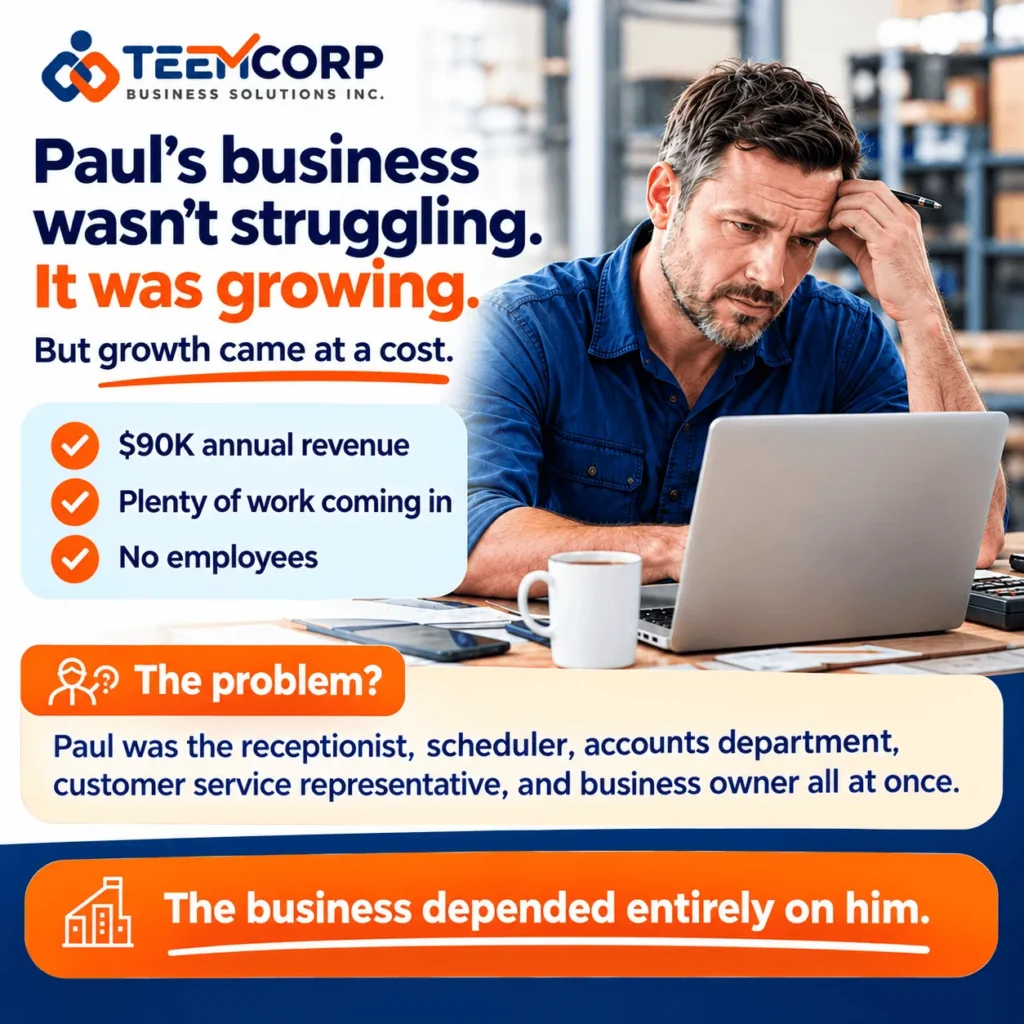
Many Australian small business owners face the same challenge: demand is growing, but there simply are not enough hours in the day. As businesses expand, owners often find themselves managing customer enquiries, scheduling, invoicing, administration, technology, marketing, and service delivery all at once. While this hands-on approach helps businesses get started, it can eventually become the biggest obstacle to small business growth. This small business case study explores how one Australian trade services business created additional capacity, improved operational efficiency, and built scalable business systems that supported long-term growth. Paul built his trade services business from the ground up. After four years of hard work, the business was generating around $90,000 per year. Demand was steady, customers continued to enquire about services, and Paul had earned a strong reputation within his local market. However, one challenge continued to hold the business back. Despite the growing demand, the business could not grow any further without him. Like many owner-operated businesses, critical functions such as customer service, scheduling, invoicing, administration, technology, and marketing remained heavily dependent on the owner. Although this approach worked in the early stages, it eventually became a barrier to sustainable growth. The business was not short of demand. Instead, it was short of capacity. As a result, growth opportunities became increasingly difficult to manage, even though there was no shortage of work available. According to the Australian Chamber of Commerce and Industry, many Australian businesses continue to face ongoing skills shortages and rising labour costs. Consequently, many organisations are exploring alternative workforce models and overseas talent solutions to access specialised skills, improve operational capacity, and support sustainable small business growth. The Small Business Growth Challenge Facing Australian Business Owners Like many small business owners, Paul gradually became responsible for every function of the business. At first, this did not seem like a problem. When you start a business, wearing multiple hats is often necessary. Not only does it reduce overheads, but it also helps owners understand every aspect of their operations. However, as revenue grows and customer demand increases, the same approach can become a serious limitation. For Paul, administrative work was beginning to pile up. Meanwhile, customer response times were becoming slower. In addition, new opportunities were being missed simply because there was not enough time available to follow them up properly. Most importantly, every hour spent on administration was an hour not spent generating revenue. As a result, Paul began to realise that the real question was not: How do I get more customers? Instead, the question became: How do I create enough capacity to serve more customers? That shift in thinking ultimately changed the direction of the business. Rather than immediately hiring additional tradespeople or increasing fixed overheads, Paul decided to identify exactly where his time was being consumed. The answer was clear. Simply put, too many important business functions were dependent on the owner. Consequently, every operational issue, customer request, and administrative task eventually made its way back to Paul. To solve the problem, he partnered with TeemCorp’s Workforce Solutions team to identify practical ways to create additional capacity without significantly increasing local staffing costs. Creating Capacity Through Workforce Solutions To begin with, the first recommendation was straightforward. Paul needed administrative support that could take ownership of routine yet essential business functions. As a result, he could spend more time focusing on revenue-generating activities and long-term business development. A highly qualified personal assistant was brought into the business, taking responsibility for: This support formed part of a broader https://teemcorp.com.au/business-support-services/business support services strategy designed to reduce owner workload, improve customer responsiveness, and create additional capacity for growth. However, the support extended far beyond administration. The assistant became a valuable point of contact for customers and helped ensure enquiries were handled promptly. For example, when Paul was travelling between jobs, the assistant could monitor schedules, provide updates to customers, and answer routine questions on his behalf. Although these tasks may seem small individually, together they delivered significant improvements. As a result: The investment was approximately $2,000 per month. However, for Paul, it represented far more than the cost of an assistant. Instead, it was an investment in buying back his time, improving efficiency, and creating capacity for future small business growth. From Working in the Business to Working on the Business Before hiring support, most of Paul’s day was spent reacting to immediate demands. Customer calls needed attention. Emails required responses. Quotes had to be prepared. Invoices needed to be issued. Meanwhile, scheduling and customer updates continued to compete for time. Consequently, strategic activities such as planning, marketing, business development, and process improvement were often pushed aside. With support in place, Paul could finally focus on the activities that drive long-term success. These included: This represented the first major shift in the business. Nevertheless, administrative support alone would not create a scalable operation. To achieve sustainable small business growth, Paul also needed documented systems, stronger processes, and technology capable of supporting future expansion. Frequently Asked Questions About Small Business Growth How can a small business create more capacity? Small businesses can create additional capacity by delegating administrative work, outsourcing specialist functions, implementing systems, and adopting technologies that reduce manual tasks. When should a business hire administrative support? Administrative support becomes valuable when business owners spend more time handling operational activities than focusing on revenue generation, sales, customer relationships, and business growth. Why are systems important for business growth? Systems improve consistency, reduce errors, increase efficiency, and make it easier for businesses to scale without relying on a single individual. What are the benefits of workforce solutions? Workforce solutions provide access to skilled professionals, improve operational capacity, support growth, and help businesses manage costs more effectively. How can business support services improve efficiency? Business support services help reduce administrative workloads, improve responsiveness, streamline operations, and allow business owners to focus on strategic growth activities. Is Your Small Business Growth Being Limited by Capacity? If you are spending too much time on administration, customer enquiries, scheduling, invoicing,
Offshore Workforce Solutions: Reduce Costs & Increase Capacity

Offshore workforce solutions are becoming an increasingly popular strategy for small businesses looking to reduce costs, increase capacity, and scale efficiently. Rising labour costs, staff shortages, and economic uncertainty are encouraging many Australian businesses to explore smarter ways to grow while controlling overheads. According to recent NAB SME insights, many Australian businesses continue to experience margin pressure from rising overheads and softer trading conditions. As a result, more business owners are focusing on efficiency, cost control, and alternative workforce strategies to support growth. At the same time, the Australian Bureau of Statistics Wage Price Index continues to highlight ongoing wage growth pressures across Australia. For many SMEs, local hiring is becoming increasingly expensive, making it harder to expand teams without impacting profitability. For many business owners, the challenge is not finding customers. The challenge is finding enough time, resources, and support to keep up with growth. Administrative work builds up. Customer enquiries require attention. Reports need to be completed. Schedules need to be managed. Business owners often spend more time keeping the business running than growing it. If this sounds familiar, you’re not alone. Many Australian businesses do not have a demand problem. They have a capacity problem. That’s where offshore workforce solutions can help. Teemcorp helps Australian small businesses reduce costs, increase capacity, and scale efficiently through fully managed workforce solutions. Businesses gain dedicated offshore professionals while retaining day-to-day control of their operations. Teemcorp manages recruitment, onboarding, workforce administration, and employee support, allowing business owners to focus on growth. Common Challenges Facing Small Businesses Many Australian SMEs encounter the same obstacles as they grow: Over time, these challenges can create bottlenecks that limit growth and reduce productivity. The Capacity Trap Many business owners wear too many hats. On any given day they may be responsible for: As the business grows, so does the workload. Eventually, there simply are not enough hours in the day. Signs Your Business Has Reached Capacity The problem is often not demand. The problem is capacity. What Are Offshore Workforce Solutions? Offshore workforce solutions allow businesses to hire dedicated professionals who work remotely as part of their team. These professionals work within your existing systems, processes, and workflows. Rather than managing recruitment and employment administration internally, businesses can partner with a provider that handles the process for them. Teemcorp’s managed workforce model includes: This approach gives business owners more time to focus on customers, operations, and growth. Reduce Labour Costs Without Sacrificing Quality Labour costs remain one of the biggest challenges facing Australian SMEs. Recent ABS data shows wage growth continues to place pressure on business margins, particularly for businesses looking to expand through traditional local recruitment. Offshore workforce solutions provide access to skilled professionals at a lower cost than many local hiring options. Common offshore roles include: This allows businesses to increase capacity while maintaining stronger cost control. Increase Capacity Without Increasing Overheads One of the biggest advantages of offshore workforce solutions is the ability to grow without significantly increasing overheads. Instead of delaying growth due to recruitment costs, businesses can add resources that support daily operations. This creates more time to focus on: The result is a more scalable business that can support long-term growth. Why More Businesses Are Choosing Offshore Workforce Solutions Australian businesses are increasingly looking for ways to improve efficiency and control costs. Recent SME market analysis indicates that many businesses are investing in productivity improvements, workforce optimisation, and operational efficiency initiatives to protect margins and improve performance. This trend is driving increased adoption of offshore workforce solutions. Key benefits include: For many growing businesses, offshore staffing is no longer viewed as a temporary solution. It has become a practical long-term business strategy. Real Business Outcomes Offshore workforce solutions deliver more than cost savings. They help businesses create capacity, improve service delivery, and strengthen operations. Teemcorp supports Australian businesses with dedicated offshore professionals across administration, customer service, operations, lead generation, and back-office support. This allows business owners to spend less time managing routine tasks and more time focusing on business growth. To see how businesses have benefited from our workforce solutions, read our case studies. Businesses commonly achieve outcomes such as: The Teemcorp Difference Teemcorp was built around a simple objective. Help Australian small businesses reduce costs, increase capacity, and scale efficiently. Our workforce solutions are designed to be practical, scalable, and commercially focused. Businesses benefit from: Our goal is simple. Provide businesses with the support they need to grow without adding unnecessary complexity. How to Get Started with Offshore Workforce Solutions Getting started with offshore staffing is often easier than many business owners expect. The first step is identifying tasks that consume valuable time but do not require direct owner involvement. These tasks may include: Teemcorp supports businesses throughout the process, including recruitment, onboarding, workforce administration, and ongoing employee support. This creates a simple pathway to building additional capacity without significantly increasing costs. For more business insights, visit our resource centre. Frequently Asked Questions What is offshore staffing? Offshore staffing allows businesses to hire dedicated professionals located overseas who work as part of their team. Is offshore staffing suitable for small businesses? Yes. Many Australian SMEs use offshore staffing to reduce costs, increase capacity, and support sustainable growth. What roles can be outsourced? Common roles include administration, customer service, bookkeeping, lead generation, virtual assistance, sales support, and operational support. Why are more Australian businesses using offshore workforce solutions? Rising labour costs, ongoing skills shortages, and pressure on business margins are encouraging Australian businesses to explore offshore workforce solutions. NAB and ABS data show businesses are increasingly focused on efficiency, cost control, and scalable workforce strategies. Do businesses maintain control of their team? Yes. Businesses retain day-to-day operational control while Teemcorp manages recruitment, onboarding, workforce administration, and employee support. Ready to Build Capacity Without Adding More to Your Day? Growth should not be limited by rising labour costs, staff shortages, or lack of capacity. With the right workforce strategy, businesses can improve productivity, increase capacity, and scale efficiently. Teemcorp